
Insulation in timber houses: do they really keep the heat in?
Published on 17 July 2026 · Updated on 24 September 2026 · Moduly Homes
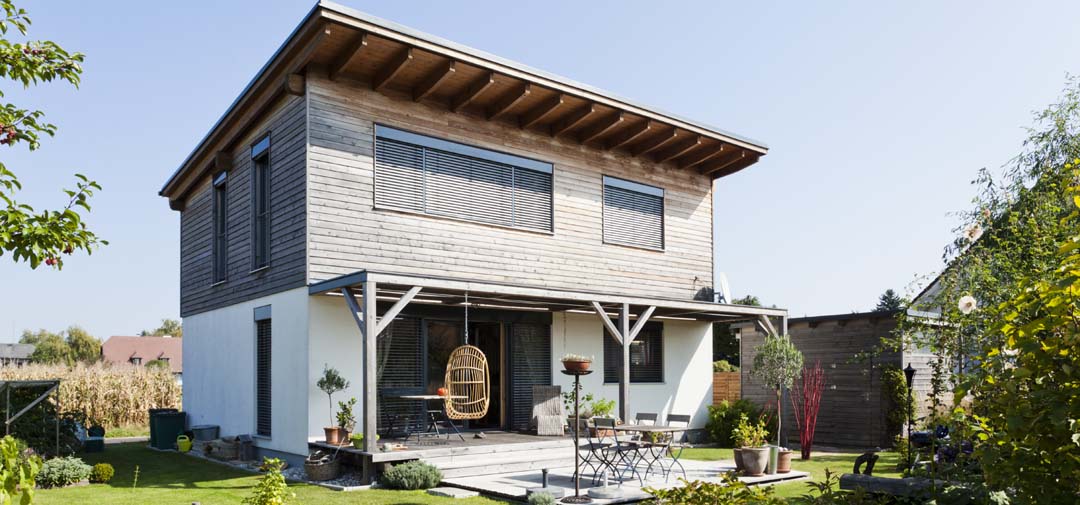
A timber house can be superbly insulated, but the wood is not what does it: the material added to the walls, roof and floor does, together with its thickness. Here you will see which insulation prefabricated timber houses use, what the law requires and what to ask before buying, especially if it is a kit.
Quick answer
Wood helps, but it is not what insulates. It lets through far less heat than concrete (more than ten times less), but an ordinary insulation material stops it much better than wood does (three to five times better). What decides is the insulation and its thickness.
A thin plank wall with no insulation does not reach the minimum of Spain's Technical Building Code in any climate zone of the country, and some kits are sold like that: the insulation goes on separately, and the kit price does not include it.
Mineral wool dominates: it is the one named by 81% of the timber houses that state their insulation (278 houses). Natural materials, such as wood fibre or cork, are a minority (18%).
“SATE” (external thermal insulation) is not a material: it means insulating the outer face of the wall. It tells you how the house is insulated, not with what.
To compare two houses, ask for the material and thickness of the insulation in the walls, roof and floor, and look at the windows, which are the weak point: the law lets them lose about four times as much heat as the wall.
| Type of timber house | Where the insulation goes | What it is insulated with | What to check |
|---|---|---|---|
| Light timber frame | Between the studs (sometimes also outside) | Mineral wool, wood fibre or cellulose | Thickness and sealed joints |
| Solid timber or CLT | Outside (SATE) or in an inner lining | Wood fibre, mineral wool or cork | That the added layer is there |
| Solid plank or log | Sometimes nowhere | Whatever is added, inside or outside | Whether the price includes it |
| Sandwich panel (SIP) | In the core of the panel | Polystyrene or polyurethane | Joints between panels |
Do timber houses insulate well? Yes, if they have insulation
Wood starts with an advantage, but it cannot do the job alone. It lets through far less heat than concrete, brick or steel, which is where its reputation as a warm material comes from. But any ordinary insulation material stops heat much better than wood does.
You can see it in what the Technical Building Code requires in the coldest zone of Spain: to meet it with wood alone, the wall would have to be more than 30 cm thick; with insulation, a layer about four times thinner is enough. That is why, in a timber house, what insulates is the added material, and what you compare is which one it has and how thick it is.
The flaw in some kits: plank houses with no insulation
Some timber house kits are sold with no insulation in the walls, just solid plank walls, and not only cabins: large houses too. As they are, those walls do not reach what the Technical Building Code requires of a home in any zone of Spain, not even on the coast of the Canary Islands, the mildest one: with wood alone you would need more than 14 cm, and the planks in these kits are much thinner.
- This applies to every new home: the only exceptions are detached houses of less than 50 m² of usable floor area.
- In the Sweden by SODO Casa (in Spanish), a kit priced at 55,350 €, the insulation for the walls, roof and floor is paid for separately.
Before comparing timber house kits by price, add what it costs to insulate them.
What insulation prefabricated timber houses use
Mostly mineral wool. Among the timber houses that name their insulation:
- Mineral wool: 125 houses specify rock wool, 11 glass wool and 89 just say “mineral wool”, the family that includes both.
- Natural materials: 19 cite wood fibre, like the Nausicaa by Caleba (in Spanish), and 30 cork, cellulose, flax or wood shavings.
- Plastic foams (polystyrene or polyurethane): 46 houses.
More than the name, compare the thickness and how far it reaches: the Nausicaa has wood fibre in the walls, but the roof insulation is chosen separately; the Evermod Max by Inove Urban (in Spanish) fills almost its entire wall with rock wool.
SATE: not a material, but insulation on the outside
SATE is the Spanish acronym for an external thermal insulation system: insulation boards glued and anchored to the outer face of the wall, then covered with a mesh-reinforced render. It is a way of fitting the insulation, not a material.
Its advantage is that it forms a continuous layer, with none of the joints where heat escapes (thermal bridges), and it can be fitted on timber. Inside it there may be polystyrene, mineral wool, cork or wood fibre, so “it has SATE” tells you how the house is insulated, not with what.
The acronyms on the spec sheet, in plain words
What usually appears without explanation:
- XPS: extruded polystyrene. It barely absorbs water and bears weight well, which is why it is used under the floor.
- EPS: expanded polystyrene, the white foam used in packaging.
- PUR and PIR: polyurethane foams, among the most insulating for a small thickness.
- Mineral wool: the family of rock wool and glass wool. It also insulates against noise and resists fire.
- λ (lambda): how much heat an insulation material lets through. The lower it is, the less thickness you need to insulate the same, and the manufacturer declares it in the CE marking.
What about winter, summer or noise?
Here the whole wall matters, not the material on its own:
- Winter: insulation thickness, an airtight wall and good windows, which are the weak point. Taken to the extreme, this is the Passivhaus standard.
- Summer: wood is light (about five times lighter than concrete) and stores little of the night's coolness. What matters most is keeping the sun out: eaves, shutters and well oriented windows.
- Noise: wood alone does not stop it either. What works is a two leaf wall with the cavity filled with absorbent material, which can be the same wool that insulates against the cold.
- Moisture: ask how the wall prevents the vapour from inside the house from condensing within it.
Being made of wood does not tell you whether a house insulates well: the insulation in its walls, roof and floor, its thickness and the windows do. Ask for that information in writing and use it to compare the prefabricated timber houses on Moduly Homes.
Frequently asked questions
Is wood a good thermal insulator?
Better than concrete, brick or steel at the same thickness, but much worse than any insulation material. That is why a timber house insulates well when it has insulation in the walls, roof and floor, and what makes the difference between two houses is that material and its thickness.
What insulation does the law require for a timber house?
The same as for any new home. Spain's Technical Building Code sets how much heat each part of the house may let through, and it is stricter the colder the zone, which depends on the province and the altitude of the plot. The only exceptions are detached houses of less than 50 m² of usable floor area.
What insulation do prefabricated timber houses use?
Mostly mineral wool, either rock or glass wool. Natural materials such as wood fibre, cork or cellulose are a minority, and there are also houses with polystyrene or polyurethane foams. More than the name, compare the thickness and check whether it also covers the roof and the floor.
What is SATE? Is it an insulation material?
No. It is a system: insulation boards glued and anchored to the outer face of the wall and covered with a reinforced render. It forms a continuous layer that avoids thermal bridges, and inside it may have polystyrene, mineral wool, cork or wood fibre. “It has SATE” tells you how the house is insulated, not with what.
Do timber houses insulate against noise?
Wood alone, not much, because it is light. What insulates against noise is the complete wall: two leaves with the cavity filled with an absorbent material. What the law requires depends on the noise in the area: the noisier it is, the more insulation it demands of the façade.
I already have a timber cabin or house. How do I insulate it?
From the inside, with an inner lining filled with wool, or from the outside, with SATE, which avoids thermal bridges but changes the façade. If the house has 50 m² of usable floor area or more, whatever you change must meet the minimums of the Technical Building Code. First, have a professional look at the wall: insulating a timber wall badly can cause condensation inside it.
Sources
Most of the sources are official Spanish documents, in Spanish.
- 1Ministerio de Vivienda y Agenda Urbana. Código Técnico de la Edificación, DB HE Ahorro de energía (junio de 2022): transmitancia límite de muros, cubiertas y huecos por zona climática, edificios excluidos, estanqueidad y control solar · codigotecnico.org
- 2Código Técnico de la Edificación. Documento de apoyo DA DB-HE/1: cálculo de la transmitancia de un muro · codigotecnico.org
- 3Instituto Eduardo Torroja (CSIC). Catálogo de Elementos Constructivos del CTE: conductividad y densidad de la madera, el hormigón, el acero y los aislantes · codigotecnico.org
- 4Código Técnico de la Edificación, DB HR Protección frente al ruido: muros de dos hojas y aislamiento de fachada según el ruido de la zona · codigotecnico.org
- 5ANFAPA. Monográfico SATE, sistema de aislamiento térmico por el exterior (julio de 2021): componentes, aislantes y soportes · anfapa.com
- 6Moduly Homes: casas prefabricadas de madera (el aislante que declara cada fabricante) · modulyhomes.com